Too Many Resumes, Not Enough Time. How AI Candidate Matching Helps Recruiters
Company Resources

Recruiters have never had more applicants and never had a harder time hiring. Candidates now use AI to send dozens of applications a day. The pile on your desk grows faster than anyone can read it.
The result is familiar: hours spent scanning resumes, good people lost in the stack, and a time-to-hire that still sits between 44 and 68 days in many industries. Meanwhile, the tools meant to fix this are often expensive seats, pay-per-post job boards or agencies taking a cut of every salary.
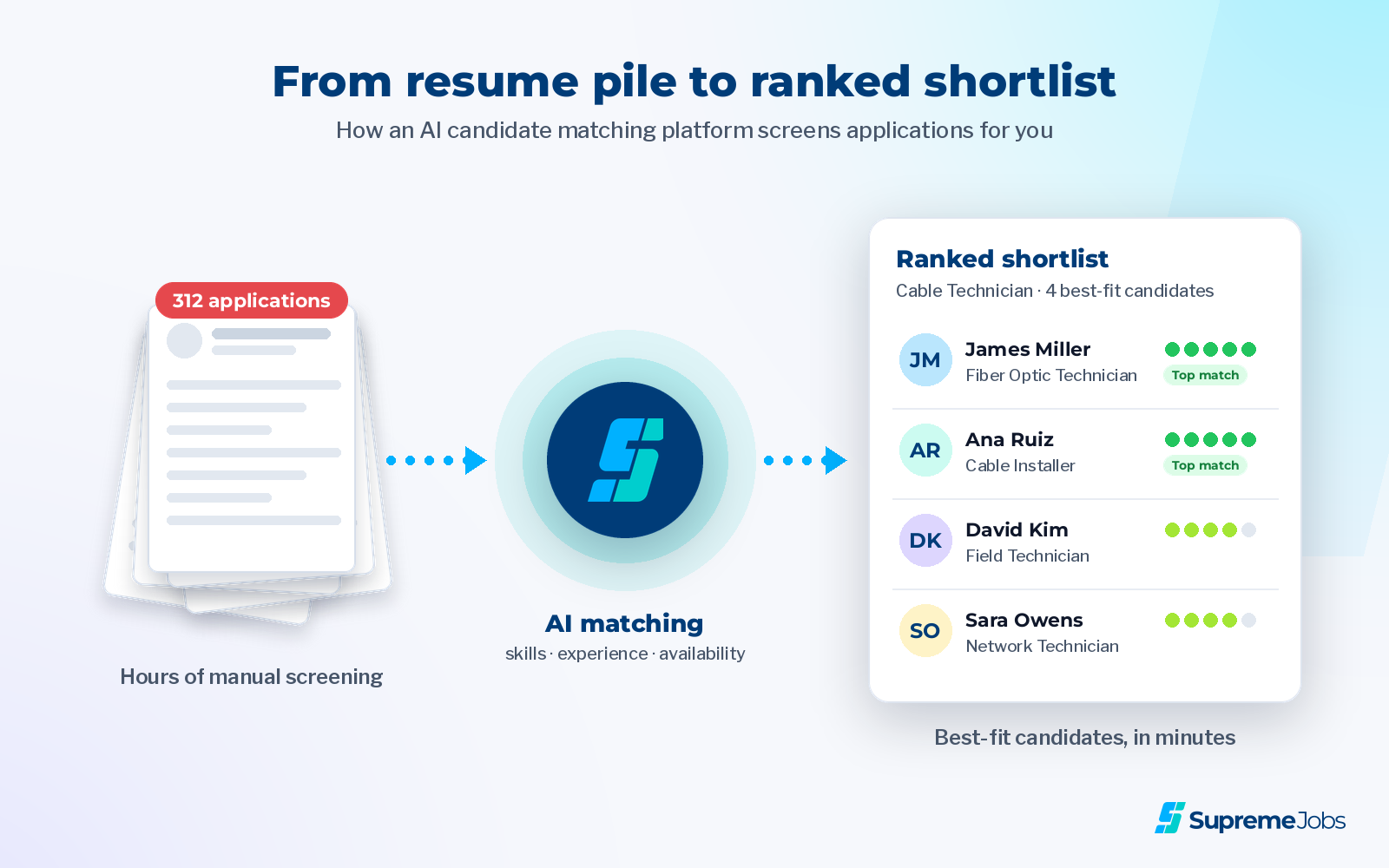
An AI candidate matching platform changes the math. Instead of reading every resume, you start with a ranked shortlist. This guide explains how it works, what it should cost, and how to use it to reduce cost per hire and time to hire in 2026.
An AI candidate matching platform is an online recruitment platform with AI-guided features. It compares each applicant's profile against the requirements of your role. It reads skills, experience, location, availability and preferences, then ranks candidates by how well they fit. You stop sorting and start deciding.
Good platforms go further than ranking applicants. After you publish a job, they surface people who have not applied yet but match the role, so you can invite them directly.
The candidate matching score turns fit into something you can see at a glance. On SupremeJobs, every candidate gets a five-point score next to their name, in list view, card view and the pipeline. A five out of five means the profile covers the role's core requirements; a two means you can probably skip it.
The score does not make the hiring decision. It tells you where to look first. Recruiters still read the profile, check screening answers and run the interview. AI does the volume; you make the call.
Most companies already use automated resume screening, but many still rely on rigid keyword filters. A candidate who wrote "fiber splicing" instead of "fiber optic installation" gets dropped. A strong technician with a messy resume never reaches a human.
AI-based screening reads meaning, not exact words. It groups related skills, weighs experience, and keeps qualified people in the running even when their resume is not perfectly worded. SupremeJobs reports that recruiters spend up to 72% less time screening resumes this way.
A skills-based hiring platform matches people on what they can do, not only on job titles or degrees. That matters in trades, logistics, automotive and defense roles, where certifications and hands-on experience count more than a diploma. Hiring for skills opens your role to candidates a title search would never show you.
The fastest way to reduce cost per hire is to stop paying for volume you cannot use. Industry benchmarks put the traditional average near $4,800 per hire, while AI-driven hiring brings it into the $250–$1,100 range. The savings come from three places: fewer paid posts, fewer hours screening, and fewer roles handed to agencies.
Cheap is not the same as affordable. Affordable job posting sites give you reach and fit for the price, not just a listing that collects hundreds of unqualified applicants. Look for:
If you hire for several locations or shifts, you need to post multiple jobs at once and manage them in one place. SupremeJobs subscriptions are built around multiple job postings, with AI help writing each job description. You fill in the role, pick a prompt, and publish in minutes.
Job boards have a huge network and rich profiles. It also comes with expensive per-seat licences, noisy outreach and a pool made mostly of passive candidates who may not be looking. For roles in trades, logistics or defense, many of the people you need are not active there at all.
| Option | Good for | The catch |
|---|---|---|
| Job boards | Volume and quick reach | Pay per post, low-quality applicants, no fit signal |
| LinkedIn Recruiter | Large network, rich profiles | Costly seats, mostly passive candidates |
| Recruitment agencies | Done-for-you shortlists | 15–30% commission per hire, less control |
| AI candidate matching platform | Ranked, active candidates in one dashboard | Final decisions done by human recruiters |
Agencies save time but take 15–30% of a first-year salary for every placement. An alternative to recruitment agencies keeps the shortlist quality and removes the commission. With AI matching, your own team gets pre-ranked candidates and keeps full control of the process.
Waiting for applicants is only half of recruiting. Resume database access lets you search the full candidate pool by skill, experience, education, language, location and availability, then reach out first.
The value of a database depends on how fresh it is. On SupremeJobs, resumes must be kept up to date and inactive profiles expire, so you only see people who are open to work or actively job-hunting.
For a hard-to-fill role, it can be faster to buy candidate resumes than to wait. SupremeJobs shows each matching profile with its score before you buy. You unlock only the resumes worth your budget, then invite those candidates to apply with one click.
Top candidates are often gone before a slow process ends. To reduce time to hire, every applicant needs to move forward without getting stuck in an inbox or a spreadsheet.
Kanban applicant tracking shows each job as a board with columns: New, Processing, Interview, Offer, Hired and Rejected. You drag a candidate card to the next stage, and the matching score stays visible on every card. Teams that need detail can switch to list view, sort and filter, and add internal notes.
Hiring is a team sport. A collaborative hiring dashboard lets you invite recruiters, assign candidates to an owner and see who is handling what. On SupremeJobs, you invite a recruiter by name and email, then assign one or several candidates to them in a single step. Nothing gets lost between colleagues, and decisions happen faster.
Post your first jobs, see your matching candidates instantly and bring your team into one dashboard. Explore SupremeJobs for employers or choose a plan.